
Investors hide in gold and silver as Trump turns on allies
President Trump, for better or worse, is basking in the geopolitical limelight.
Shortly after he toppled the Venezuelan president on Jan 3, the Trump administration is now orchestrating an audacious grab for the world’s largest island – Greenland. “We have to have it,” declares the 47th president of United States. His stance is unambiguous and determined, much to the shock of Greenland, Denmark, and the EU. Protests sprouted in numerous cities. Actions have consequences.
Will the president back down, much like the “Liberation Day” tariffs announcement? Nobody knows. Perhaps he will; perhaps he won’t.
Investors, however, are taking these events at face value as they unfold day by day. The next important meet-up is scheduled in Davos, where the US contingent will meet its European counterparts to ‘sort things out’.
Meanwhile, gold prices are appreciating day by day. The reason is not difficult to see. Hard assets are favoured during geopolitical tensions over financial ones.
Silver is doing even better. Prices are vaulting towards the $100 level with ease, rising in a parabolic trend. A climactic phase of the boom may soon follow.
If investors are sitting on sizeable (and profitable) long positions here, trend riding is preferred, although stops and risk adjustments must be implemented and respected.

Is it time to ‘Sell US’?
Given the ongoing political squabble between America and its traditional European allies, investors are left wondering: Is it time to sell US assets?
There are a few reasons for this trade:
- US equity assets are highly valued (some say overvalued) and major stock indices (S&P and Nasdaq) are at all-time highs
- “Trump Drama” will probably go on for another 2-3 years, meaning uncertainty will only increase
- A paradigm shift in US monetary policy (ie, new Fed chair in 2026)
These are downside risk factors. Plus, hedging isn’t that expensive (yet).
But what assets are investors looking to sell here?
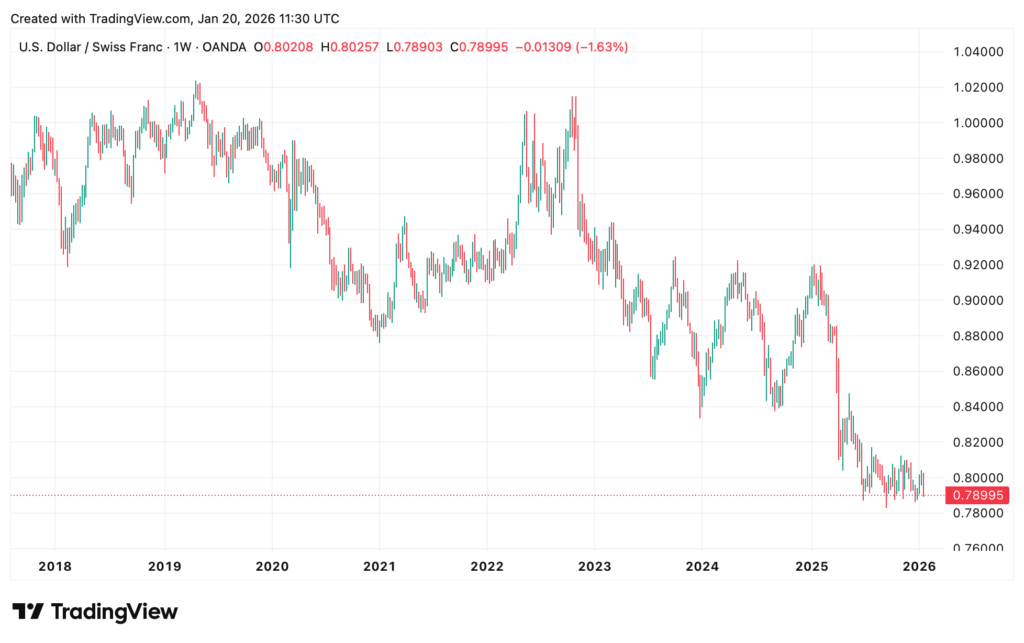
The first obvious point is the USD. But, the dollar has many counterparts – GBP, EUR, JPY etc. So which pair are we looking at?
The FX pair that is showing the weakest USD is USD-CHF. The rate is on a multi-year decline. Prices, as you can see below, have not even recovered from the damage inflicted by last year’s tariff shock.
The latest Greenland fiasco is causing the rate to tumble close to all-time lows (see below). Hence, I suspect this FX rate will be the first to reach new lows if tensions increase.
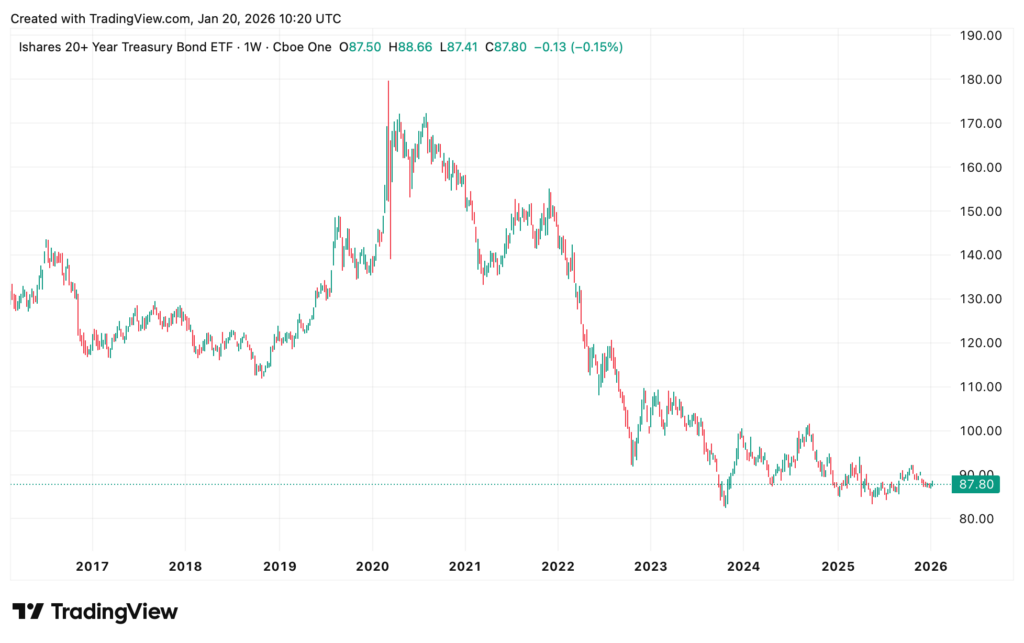
What about US Treasury bonds? Should we short that too?
The asset class, especially long-maturity ones, is “relatively” weak compared to stocks. On an absolute basis, prices have not reacted much to the downside. There are two forces holding the asset class.
The first is subdue inflation. The past year saw no major increase in inflation expectations – despite increased tariff rates. This put investors at ease about renewed monetary tightening. The second is a potential shift in the Fed makeup this year. Investors are expecting a ‘accommodative’ shift in the Fed policy once the next chair is confirmed.
Until we see a decisive downside break, Treasury bonds may continue to drift sideways.
The last asset to sell is US equities.
This is the most volatile and unpredictable option. This is because many US stocks are still hitting all-time highs. Upward momentum is strong; as is risk appetite.
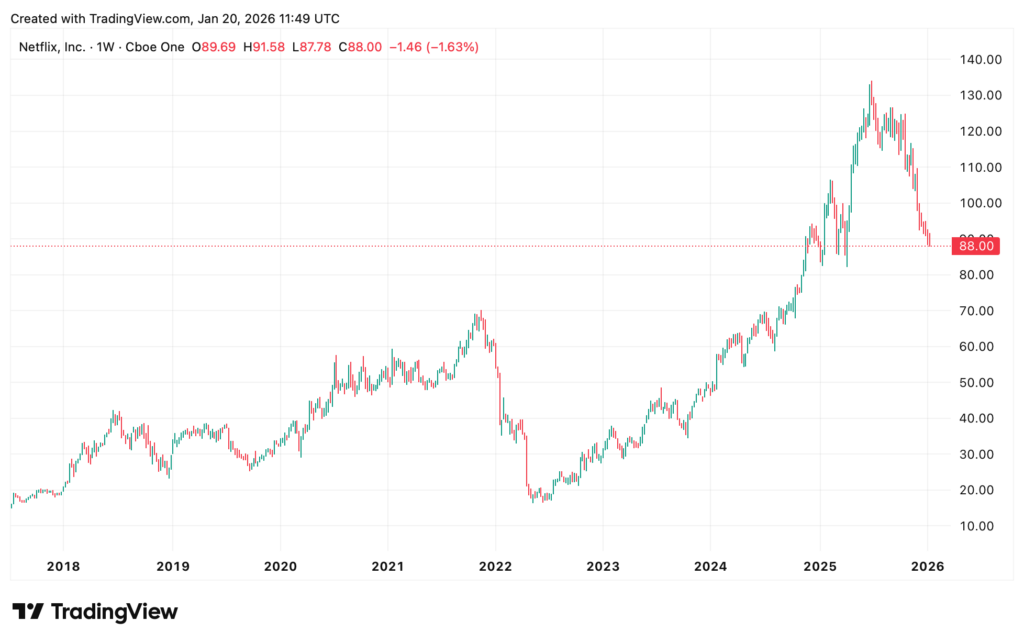
Of course, this is not to say everything is all well and rosy out there. For bearish positions, I’d pick equity instruments that have turned down decisively on a long-term basis.
One example is Netflix (NFLX), the online entertainment streaming platform. Prices are tumbling to multi-month lows beneath the $100 level. The chart pattern resembles a major top.
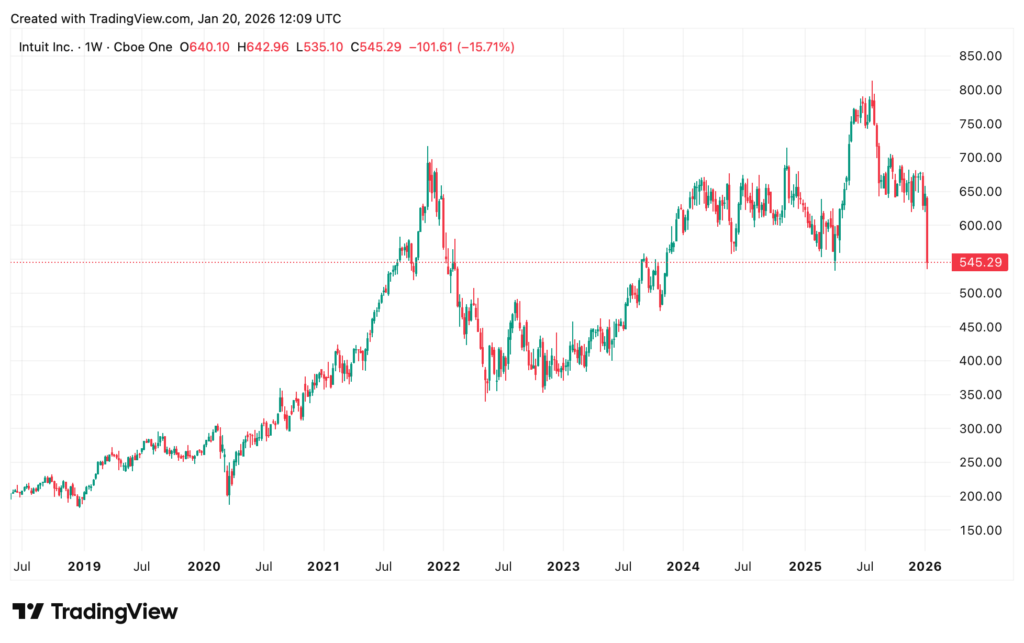
Another is Intuit (INTU), the $150 billion software company. Prices slumped to 52-week lows last week after months of tight trading.
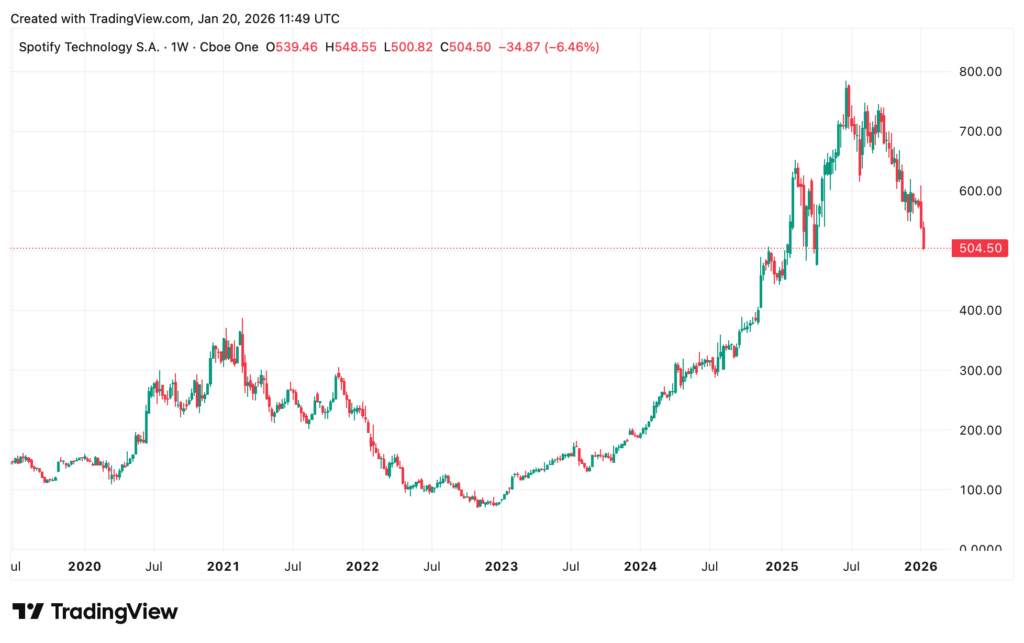
Spotify (SPOT) is another toppy-looking stock (see below).
In other words, there are a number of large- and mid-cap US stocks that are cruising lower and cutting through multi-quarter support levels. I would scan which stocks are hitting 52-week lows and start from there to find equity candidates to short.
What should investors do?
With the ongoing drama surrounding Greenland, many are looking to take a ‘Sell US’ stance. The idea is that the simmering tension will increase in the days to come. Some US assets have depreciated in reflection of this unexpected catalyst.
But is the Sell US strategy this is a ‘sure thing’? Trump has a habit of backing off when the going gets tough. Don’t forget he likes to make deals, too. As he wrote in the opening paragraph of his book, The Art of the Deal:
I like making deals, preferably big deals. That’s how I get my kicks.
If risk assets like stocks do get smashed in the process of the negotiation, this collateral damage may present a buying opportunity that many have been waiting for. An overly bearish stance is not advised.
