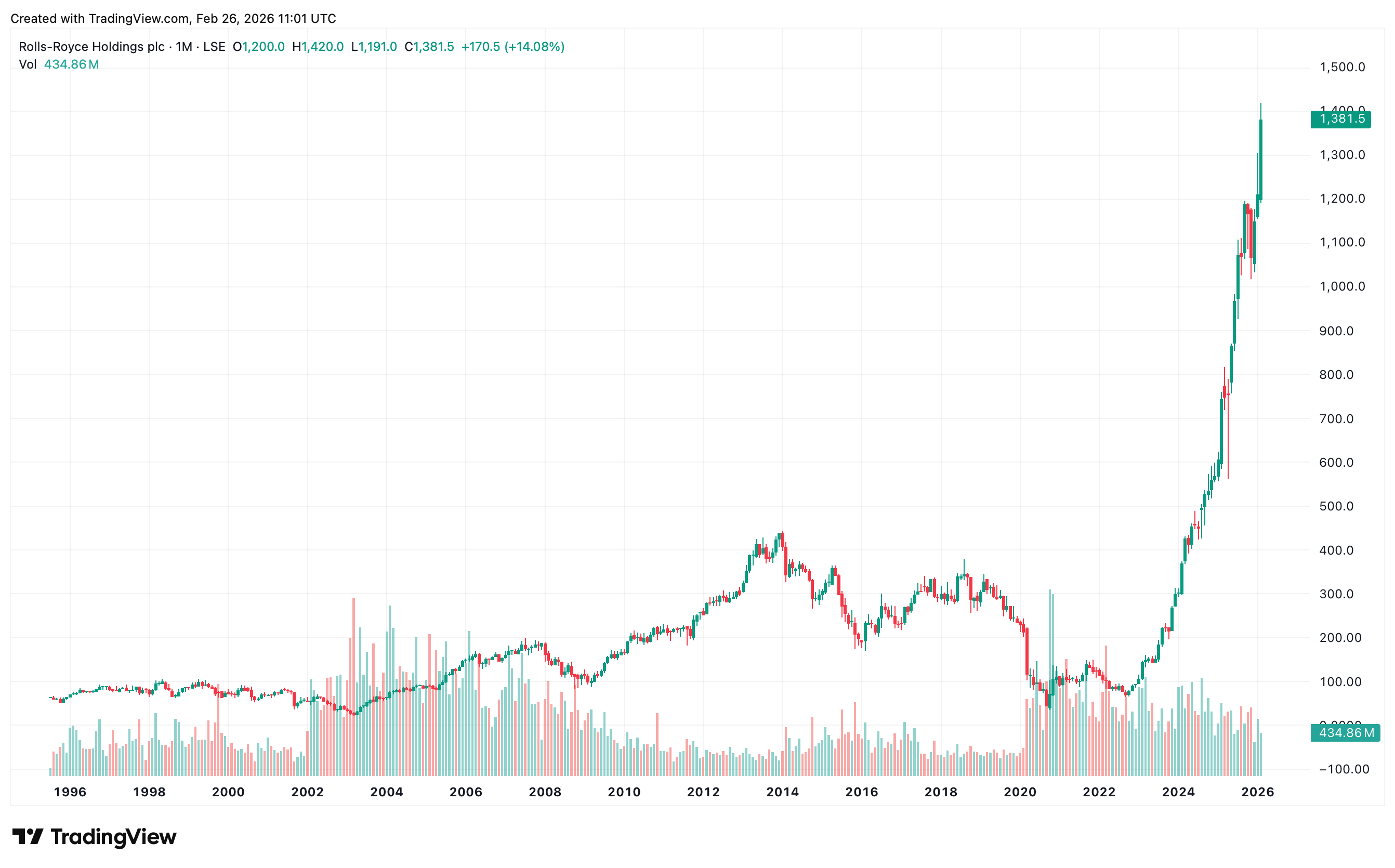
Rolls Royce jumped on excellent results and buybacks
Rolls Royce’s (RR.) growth results today continues to unpin its excellent recovery.
Over the past 5 years, Rolls Royce outperformed almost every other large cap stock in the UK. Prices rallied 20x from its 70p pandemic low. Investors who stayed steadfastly in the aerospace stock had reaped a fortune.
By comparison, the FTSE 100 Index only put on a 120 percent gain.
If you look at Rolls Royce’s long-term (monthly) chart, the trend is unmistakably bullish. New price high today on good results means investors are still buying. Upward momentum may carry the stock to £15 in the near term.
That said, whenever a stock has rallied 2,000% to 3,000% (which Rolls Royce is now a member), I’m quite wary about its ‘long term’ prospect. Why? For two reasons.
One, the proverbial 20-bagger is usually a massive price swing from oversold (and unowned) to overbought (and over-owned). Those who needed to own the stock are probably already in it. To move a £100 billion stock would take much more institutional buying.
Two, investors tend to extrapolate future returns like the recent past. Whenever they see a 10-bagger, they immediately jump in and expect Rolls to engineer another 10x from current prices.
Can Rolls do this? A 10x performance from here would catapult RR. to the £1trillion mcap mark. This puts its fabulous market cap-to-UK GDP at 33% ($1.38t vs $4t).
I suspect this figure is somewhat unrealistic. Even the $5 trillion Nvidia doesn’t fetch those ratios. So if Rolls’ share price were to vault to £150 per share, it may well present the Short Opportunity of the Decade, even factoring in decent profit growth.
For now, Roll’s chart suggests we stay long.
But investors got to have some exit plans. Do we reduce holdings near round number levels? Do we buy back at lower levels? Et cetera.
Sometimes, investing in the latter phase of a bull market is harder than at the bottom. If you get off early, you missed out large potential profits. If you jump out late, you give back significant profits. In investing, timing is of the essence.